 Back to Blog
Inside the Quiet Work of Threat Hunting
The term "threat hunting" spread across conference booths and job descriptions long before anyone agreed on what it meant. Marketing teams liked it because it sounded active. Executives liked it because it implied a stronger posture. But the work itself never changed. It was always structured investigation, patient and evidence-driven, practiced long before anyone tried to brand it. The discipline deserves clarity. Without a framework, hunting is just a label that hides inconsistent practice.

It was late in northern Virginia and the building felt abandoned in that unsettling way offices do after everyone has gone home. The lights hummed overhead. The carpets held the day’s warmth while the air vents pushed a colder current across the floor. Somewhere down the hallway a printer woke up for no reason, chattering to itself and then falling silent again. Inside a small conference room sat a few laptops, a stack of blank notepads, and a pot of coffee that looked as if it had survived several meetings before ours. The customer had no alerts to speak of, only a quiet worry that had grown over weeks. Their administrators could not point to a single event. They only felt that the environment no longer moved the way it used to.
We began collecting data one system at a time. Domain controllers. Application servers. Workstations that someone flagged as important even if they could not explain why. We reviewed logs line by line. We checked the usual artifacts. We followed faint signals into places where attackers like to hide. There was nothing dramatic about it. The work felt almost routine, the way any good investigation begins. Years later, when the word “hunting” became a centerpiece of marketing slides, I thought back to that night. The work had structure. It had purpose. It required patience. It never needed a name to make it sound bigger.
The Term Grew Faster Than the Practice
Not long after that period, threat hunting became the headline word across conferences. RSAC booths promoted hunting services with bright graphics. Black Hat vendors talked about hunters as if they were a new class of operator. The term spread quickly, and it spread for reasons that had little to do with tradecraft. Marketing teams pushed it because it sounded active and exciting. Executives liked it because it suggested a stronger security posture. Recruiters added it to job descriptions because it stood out. The work itself did not change, but the language around it expanded in every direction at once.

I reviewed resumes during that wave. Some candidates listed their title as “Hunter.” I grew up near Detroit where hunters drive Up North in November with rifles and bright orange jackets. Seeing that word in a cybersecurity resume felt off. It also told me how far the industry had drifted from its roots. A job title had turned into branding, and the work behind it was losing clarity.
What Threat Hunting Actually Is
Threat hunting is structured investigation when alerts fall short. It is a deliberate search for intrusion activity using the same logic that experienced IR teams rely on during compromise assessments. The analyst follows weak signals. They check common persistence paths. They look for unusual authentication patterns. They study odd parent child process chains. They trace remote access activity that does not follow the rhythm of legitimate use. None of this is improvisation. It is careful, ordered work built on years of intrusion experience.
Patients in a hospital are monitored with vital signs. Analysts do something similar with an environment. They compare what should be stable against what has shifted. A good hunt is not about creativity. It is about disciplined curiosity and a clear sense of how systems behave when no one is tampering with them.
Real hunting requires an understanding of systems, user behavior, and attacker tradecraft. A practitioner cannot rely on instinct alone. They need to know why certain artifacts matter and how attackers use common tools to avoid detection. Without that foundation, the work is guesswork dressed up with vocabulary.
What Threat Hunting Is Not
- It is not wandering around a SIEM looking for odd events.
- It is not random queries with no plan.
- It is not a theme of the day based on something someone saw on a blog.
- It is not a task that rewards improvisation over method.
- It is not a badge that turns someone into a senior analyst.
I once saw a junior analyst present a “hunt plan” that consisted of three points. Look for anomalies. Search for weird stuff. Investigate suspicious patterns. The analyst meant well. The problem was the culture. The industry had convinced people that hunting meant roaming through data with intuition as the primary tool. That approach produces long hours and shallow findings. It also gives a false sense of coverage. A hunt must end with a clear explanation of what was checked, why it was checked, and what evidence supported each step. Without that, it is a dead end.
Why the Industry Made It Murky
The term spread before a common method existed. Each company built its own version. Some were grounded in strong IR practice. Others were stitched together to meet market demand. Training companies offered hunting courses that taught broad ideas but skipped the depth. Product vendors used the word to sell dashboards and queries. Consultants packaged old services in new wrappers. The discipline expanded horizontally with no guardrails.
I remember standing at a conference booth when a vendor tried to explain their hunting framework. Their entire model was a poster with a magnifying glass and an arrow. When I asked what methodology they followed, they had nothing. It was a strong example of how the marketing side raced ahead while the practitioners were still shaping the core idea.
The Closest Real Parallel
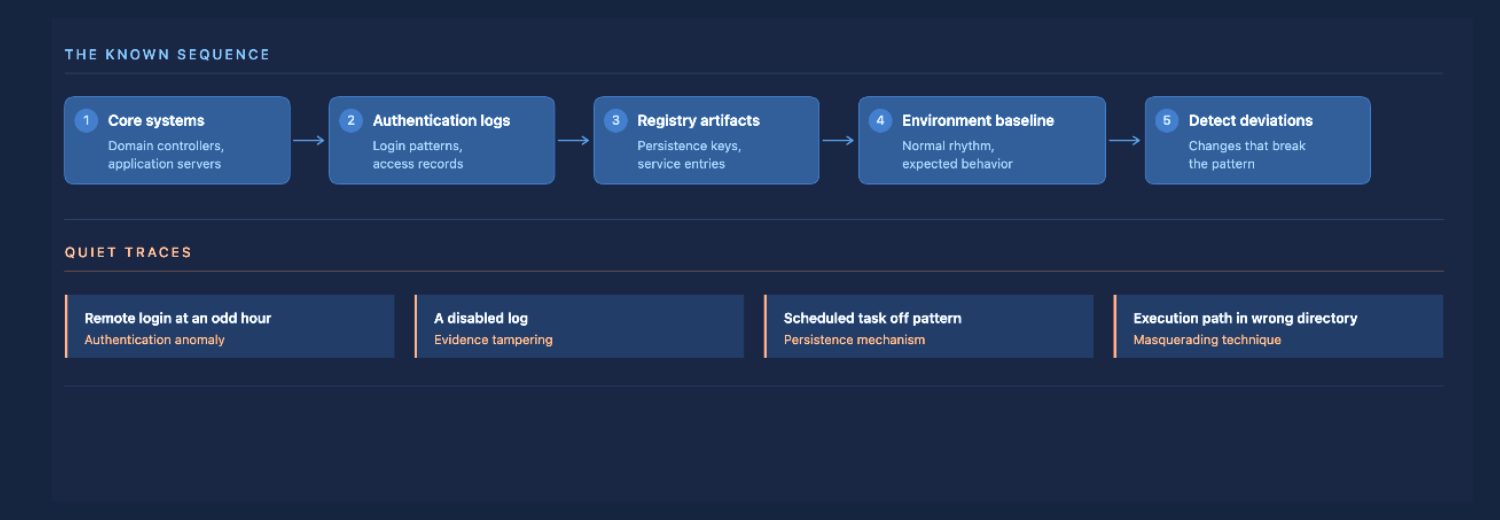
Threat hunting has always been close to compromise assessments. Early in my career at Mandiant, teams would be sent to customers who felt something was wrong but had no alerts to support the feeling. We would start at the core systems, review authentication logs, examine registry artifacts, and build an understanding of how the environment behaved over time. We looked for changes that did not match the normal rhythm of the environment. It was slow and patient work, and it followed a known sequence. There was nothing romantic about it. It was honest investigation based on evidence.
Attackers often leave quiet traces. A remote login at an odd hour. A disabled log. A scheduled task placed slightly off pattern. An execution path that looks normal but sits in the wrong directory. These small signals guide the best investigators. They do not replace structure. They require structure. The analyst needs a framework that keeps the work consistent from start to finish.
A Note on Structure
Structure is not a restriction. It is a safety net. It ensures that analysts can explain how they reached their conclusions. It stops investigations from drifting. It gives teams a way to build shared knowledge. It allows new analysts to learn while seasoned analysts remain efficient. It produces decisions that can be reviewed and trusted. Without structure, a hunt becomes a personality driven exercise. With structure, it becomes a team capability.
Modern environments are noisy. Data arrives from many sources and the industry now calls that “telemetry” (a term that did not exist in most corporate environments until former government intel staff began influencing IT security vocabulary). Analysts face pressure to work fast. A structured approach keeps them anchored. It prevents shallow searches. It forces clarity in how steps are chosen and why they matter. It also preserves institutional memory by producing work that others can understand.
This matters because performance cannot be judged without a framework. Leaders cannot evaluate a hunter’s effectiveness if every hunt is shaped by individual style rather than a common method. An analyst may have strong instincts, but instincts cannot be audited. A framework gives leaders something measurable. It highlights thorough work. It exposes shortcuts. It shows whether analysts follow evidence or fall back on habits.
Executives face their own challenge. They must approve budgets for threat hunting but have no reliable way to compare one provider to another. When a discipline has no structure, decision makers end up evaluating personalities instead of methods. Strong marketing can hide weak tradecraft. A shared framework changes that. It turns hunting into a discipline that can be reviewed, repeated, and trusted.
Real Hunting Requires Discipline
Threat hunting has survived a decade of noise. The term grew large, but the work stayed steady. It is still the search for attacker activity when alerts fall short. It is still the patient, evidence driven process that responders practiced long before anyone tried to brand it. The industry can keep the word if it wants, but the work deserves clarity. Hunting becomes stronger when it is grounded in real investigation instead of hype. With structure, it becomes repeatable and trustworthy. Without structure, it collapses into a broad label that hides inconsistent practice. The field is healthier when the vocabulary matches the work.
Key Points – TL;DR
- Threat hunting is structured investigation, not improvisation.
- The term spread faster than the method behind it.
- Without a framework, analyst performance cannot be measured.
- Executives cannot judge competence when definitions vary by personality.
- Structure turns hunting into a reliable team capability.
- The work has always existed. Only the marketing changed.
About the Author
Jeff Hamm is the Managing Director of HammNet UG and founder of Evidenx and an independent global incident response leader. He specializes in digital forensics, ransomware recovery, cyber crisis management, and the application of AI-ML in cybersecurity.